

Performance Marketing
Brand Strategy Before Advertising: Why Running Ads Too Early Gets Expensive
Running ads before defining your audience, positioning and brand message can make every campaign work harder than it should. Here’s what to fix before increasing your ad spend.
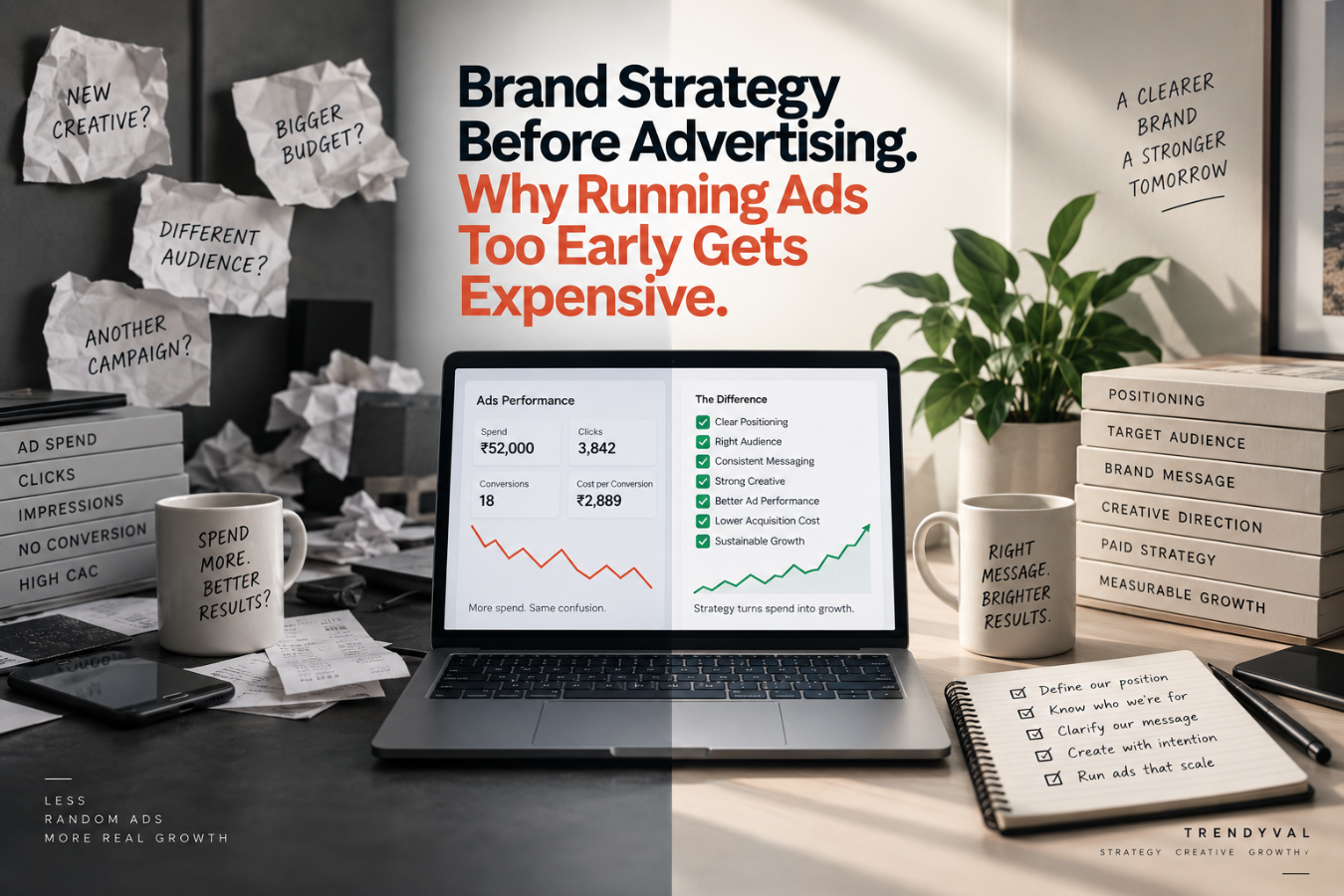
The campaign is live. People are clicking, traffic is coming in, and maybe you're even getting a few enquiries or sales. Yet the customer acquisition cost keeps creeping up, every new creative seems to start from zero, and the moment you reduce your advertising budget, demand seems to disappear with it.
The instinct is usually to change the ads: new creative, a different audience, revised targeting, another offer, another campaign.
Sometimes those things genuinely are the problem. But sometimes the issue started before the first advertisement was ever launched. The business never clearly decided who it was for, what made it different, or what people were supposed to remember about it.
That is why brand strategy before advertising matters. Paid media can amplify a strong message; it cannot manufacture one.
Advertising Buys Attention. Branding Gives It Meaning.
Advertising can put your business in front of thousands of people. That does not automatically mean those people will understand why they should care.
Consider the difference between “Premium skincare for everyone” and “Barrier-first skincare for Indian skin dealing with heat, pollution and over-exfoliation.”
Both could run as beautifully produced Instagram ads. Both could target exactly the same audience. But the second gives the customer something much clearer to understand. It identifies an audience, a problem and a point of difference.
That is positioning. And positioning affects far more than the headline of an advertisement. It influences creative direction, copy, landing pages, offers, targeting and the expectations customers carry into the buying journey.
A strong positioning strategy gives paid advertising something meaningful to communicate. Without it, the campaign is often left trying to manufacture relevance from scratch.
Why Advertising Gets Expensive Without Clear Positioning
When the brand is unclear, every advertisement has to do too much work. Within a few seconds, the ad may need to explain who you are, what you sell, why you are credible, how you differ from competitors, what the offer is and why somebody should act.
That is a lot to ask from one piece of creative. A stronger brand has already done part of that work. A potential customer may recognise your visual identity, have encountered your content before or already associate your business with a particular problem.
The advertisement is no longer introducing a complete stranger. It is continuing a conversation.
This is why a business can have technically competent ads and still struggle with acquisition efficiency. The targeting may be reasonable, the visuals may be attractive and the offer may even be competitive. But if the message could belong to twenty other businesses in the same category, the customer has very little reason to remember it.
More spend does not automatically solve that problem. In many cases, it simply distributes an unclear message to more people.
Brand Strategy and Performance Marketing Should Work Together
Marketing is often divided into two camps. Brand marketing is expected to build awareness, perception and long-term preference, while performance marketing is expected to generate clicks, leads, conversions and measurable returns.
Growing businesses are often made to feel as though they have to choose between the two. They do not.
Your brand strategy should decide what you want the market to understand and remember. Your performance marketing should distribute those ideas, test them against real audiences and turn attention into action.
When the two work together, advertising can generate results today while also making tomorrow's customer more familiar with the business. When they do not, performance marketing can become increasingly dependent on constant acquisition.
The objective should not be brand or performance. It should be brand × performance.
Four Questions to Answer Before You Run More Ads
Before opening Meta Ads Manager or increasing a Google Ads budget, the business should be able to answer four questions clearly.
1. Who Are We Actually Trying to Attract?
“Everyone” is not a useful audience. A café designed around college students will communicate differently from one built for professionals who want somewhere quiet to work or meet clients. A fashion label selling everyday clothing at ₹1,500 should not sound like a premium occasion-wear label selling at ₹15,000.
The clearer the audience becomes, the more specific the communication can become. And specificity usually makes advertising more relevant.
2. What Problem Are We Really Solving?
Customers do not always describe their needs using the language businesses use internally.
Someone may not be thinking, “I need a digital marketing agency.” They may actually be thinking, “My business looks inconsistent online and I don't know how to fix it.”
They may not be thinking, “I need a premium fitness studio.” They may be thinking, “I want to start exercising somewhere I won't feel judged.”
Good advertising begins when the brand understands the problem in the customer's language rather than its own.
3. Why Should They Choose Us?
“Best quality”, “affordable”, “premium”, “trusted” and “customer-focused” are weak differentiators because almost every competitor can say them.
A stronger position is usually more specific. Perhaps the business is faster, more specialised, more transparent or built for a narrowly defined audience. Perhaps it follows a distinctive philosophy or delivers the service differently enough that customers immediately understand why it exists.
Your answer does not have to sound clever. It has to give people a genuine reason to choose you.
4. What Should They Remember?
Imagine someone sees your advertisement today but is not ready to buy. What should remain in their mind tomorrow?
Maybe it is “the café made for working.” Maybe it is “everyday Indian clothing without occasion-wear drama.” Maybe it is “marketing for local and emerging brands that are ready to look like serious businesses.”
The exact language may evolve, but the territory should remain consistent. Advertising becomes more valuable when something survives after the impression is gone.
Brand Consistency Makes Paid Media Work Harder
Testing creative is important. A strong performance team should experiment with hooks, visuals, formats, calls to action and offers. But testing different creatives does not require inventing a different brand every week.
Your campaigns can evolve while retaining recognisable typography, colour, photography, tone, messaging territory and point of view.
If one campaign feels premium, the next feels discount-led, the next feels comedic and another looks as though it belongs to an entirely different company, very little recognition accumulates. The business keeps paying for attention without building enough memory from it.
For a small or emerging business, every rupee should ideally do two jobs: generate action today and make the next interaction with the brand slightly easier.
The first job is visible in dashboards. The second one is harder to measure, but no less important. Someone seeing your brand for the fourth time is not in the same psychological position as someone discovering it for the first.
That is where consistency begins to compound.
Before Blaming the Ads, Check the Entire Journey
Clear branding does not magically fix every performance problem. A high customer acquisition cost can come from poor targeting, weak creative, an unattractive offer, incorrect pricing, a confusing landing page, bad tracking or a product people simply do not want strongly enough.
Good marketing does not use branding as an excuse for poor execution. It looks at the entire system.
Ad → Landing Page → Offer → Proof → Conversion → Follow-up
Then ask whether every stage reinforces the same promise.
If your ad says “Premium workspace designed for founders” but the landing page says “Affordable office solutions for everyone”, the customer is suddenly dealing with a different proposition.
If an Instagram campaign looks refined and editorial but the website feels cluttered and cheap, perception changes again. If the advertisement promises personal attention but the enquiry experience feels cold and entirely automated, the promise begins to break.
Brand strategy is what connects those experiences.
The Ad-to-Landing-Page Test
One of the simplest audits a business can perform takes less than ten minutes. Open one of your current advertisements and the landing page it sends customers to. Look at them side by side.
Check whether the audience, promise, tone, visual identity, offer and proof all feel as though they belong to the same business. If they do not, fix the disconnect before immediately increasing the budget.
Then ask one more uncomfortable question:
If we removed the targeting and media spend from this advertisement, would the message itself still give someone a reason to choose us?
Good targeting can find the right person. It cannot create a strong reason to buy.
Recognition Is What Makes Marketing Compound
Imagine two businesses running paid media for a year. The first changes its message constantly. Every month brings a different style, tone, offer and positioning. Some campaigns perform, but very little carries forward.
The second business also tests aggressively, but its experiments live inside a clear strategic framework. New creatives reinforce the same broad position. The visual identity remains familiar. The tone remains recognisable. The brand keeps returning to the same useful territory.
The ads change. The brand does not.
Over time, each impression can help the next one make more sense. That is what marketing compounding looks like.
It is not about repeating exactly the same advertisement forever. It is about repeatedly reinforcing a coherent idea while continuously improving the execution.
What to Check Before Increasing Your Advertising Budget
Before putting another ₹10,000, ₹50,000 or ₹5 lakh into paid advertising, check whether the fundamentals are actually in place:
Can someone understand who the offer is for within a few seconds?
Is the benefit immediately clear?
Is there a genuine reason to choose you over another option?
Does the creative feel recognisably yours?
Does the landing page continue the same message?
Is there enough proof to reduce uncertainty?
Are your campaigns building anything people might remember even if they do not buy today?
If several answers are no, increasing spend may simply increase the speed at which you discover the problem.
Ads Should Amplify a Brand, Not Substitute for One
Advertising is powerful. It can introduce a new company to thousands of potential customers, create demand, test offers and accelerate growth far faster than many traditional channels.
But paid media works best when there is something coherent underneath it: something to recognise, something to believe, something to remember and something to choose.
That is why branding for small business should not be treated as a cosmetic exercise that happens after growth begins. It is part of the growth system itself.
You do not build the brand instead of advertising. You build the brand so your advertising has something worth amplifying.
Before launching the next campaign, ask yourself one final question:
Are we trying to solve a media problem—or are we paying media to compensate for a clarity problem?
The answer may save you far more than the next optimisation ever will.
Better Ads Often Start Before the Ads
Trendyval helps local and emerging brands connect brand strategy, positioning, creative and performance marketing into one coherent growth system.
Because better performance does not always begin with another campaign. Sometimes it begins with getting clearer about the brand behind it.